

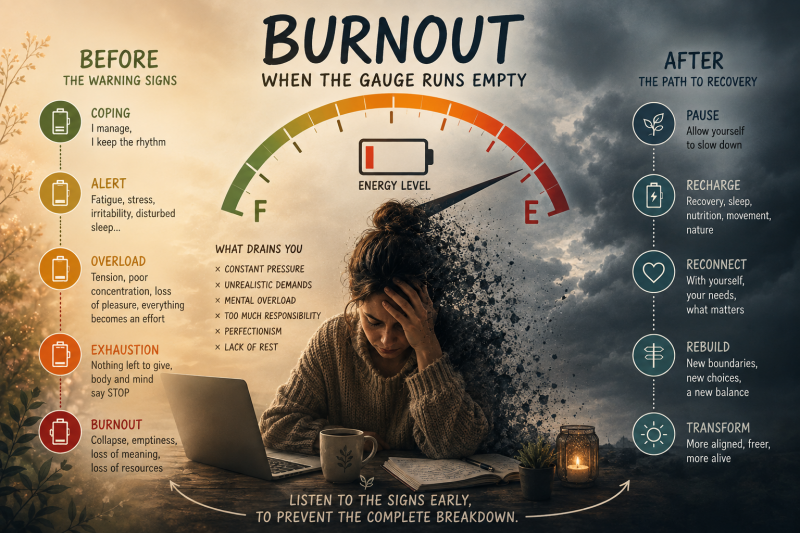
When we talk about burnout, we immediately think about work. Yet exhaustion can also be parental, family-related, connected to being a caregiver, or develop within a relationship that has become emotionally exhausting.
The context may change, but the underlying mechanism remains similar: for too long, we use more physical, mental and emotional resources than we are able to restore.
And usually, the body starts sending warning signs long before the actual collapse.
🍂 Before: the brain adapts… until it reaches its limits
At first, we keep going.
We sleep less, skip breaks, gradually give up the things that make us feel good, and keep telling ourselves: “Just a little longer. Things will get better afterwards.”
Then certain warning signs begin to appear:
-
persistent fatigue;
-
irritability and heightened sensitivity;
-
sleep disturbances;
-
difficulty concentrating and forgetfulness;
-
loss of motivation and pleasure;
-
physical tension, headaches, unexplained aches and pains despite normal medical test results — the body may begin to somatize stress;
-
the feeling of constantly being in emergency mode.
From a neuroscience perspective, prolonged exposure to stress continuously activates the systems involved in alertness and adaptation. When this state becomes chronic, sleep, attention, memory and emotional regulation can all be disrupted.
In a way, the brain learns to function in survival mode — and your amygdala may start bringing old emotional files back to the surface.
🌧️ During: when everything becomes “too much”
Sometimes, a point comes when continuing as before is simply no longer possible.
An ordinary task requires an enormous amount of energy. Noise becomes unbearable. Making even a simple decision becomes difficult. You may cry over seemingly small things or, on the contrary, feel almost nothing at all.
Brain fog sets in.
You look at yourself in the mirror and think:
“I don’t recognize myself anymore.”
This is not simply a lack of motivation.
The brain and body have been under pressure for too long without sufficient recovery.
Your emotional battery is empty.
👨👩👧 And burnout isn’t only about work
A parent can deeply love their children while still feeling completely exhausted by the demands of parenting.
Someone can love their partner while no longer having enough emotional resources to cope with conflicts, constant demands or an overwhelming mental load.
This kind of exhaustion can also affect caregivers.
Being exhausted by a situation does not mean that you no longer love the people involved in it.
It may simply mean that your resources have reached their limits.
🌲 Neuroscience: gradually moving out of “survival mode”
The good news is that our brain has an extraordinary ability to adapt: neuroplasticity.
Patterns and automatic responses that developed over months or years can gradually change.
But this requires repeatedly creating new experiences:
taking a break before reaching exhaustion;
saying no before becoming overwhelmed;
restoring regular sleep;
walking, breathing and spending time in nature — trust me, it really helps!;
reintroducing activities associated with pleasure and a sense of safety;
accepting that you do not have to be productive all the time — which can be difficult because resting often comes with guilt.
Gradually, the brain can learn something different from:
“I have to keep going.”
It can relearn:
“I can slow down without being in danger.”
✨ And what about energy?
From an energetic perspective, we can also observe what we symbolically call our “vibration”: our dominant inner state and what we cultivate every day.
During periods of exhaustion, our inner world can become almost entirely occupied by:
I have to. I must. Hurry up. I have no choice. I need to keep going. I have to take care of everything…
Our body remains tense, our thoughts revolve around responsibilities, and almost all our energy is directed outward.
Energy work can then be considered a complementary way of reconnecting with ourselves: slowing down, returning to bodily sensations, identifying what nourishes us and what drains us, and bringing intention back into our daily lives.
The goal is certainly not to force ourselves to “vibrate positively.”
You do not recover from burnout by feeling guilty because your energy is supposedly too low.
Instead, it is about gradually transforming the internal and external environments we maintain.
Moving from:
“What else do I need to somehow endure?”
to:
“What do I need to create more space within myself?”
⏳ And it takes time
There is no universal timeline for recovering from burnout.
For some people, it may take a few weeks. For others, several months or longer.
And recovery is not linear.
You may feel significantly better and then experience a few days of intense fatigue.
That does not necessarily mean you are relapsing.
The nervous system, our habits and our lifestyle cannot be rebuilt in a few days after being pushed beyond their limits for months or even years.
Time is our ally.
Slowing down and taking the time to observe what is happening within us can allow us to choose a new path towards greater serenity.
We live in a system that constantly pressures us to move faster and perform better.
But your body and your brain may be telling you the exact opposite — and I would encourage you to listen to them.
At first, the body may express chronic stress through physical symptoms. But when those warning signs are repeatedly ignored, exhaustion can become much more severe — and recovery can become considerably more difficult.
❄️ After: the “I feel better” trap
This is probably the most important part.
Your energy starts coming back and you think:
“That’s it. I can go back to how things were before.”
So you take everything back on.
Work, responsibilities, projects, social activities…
And sometimes the exact same patterns return:
perfectionism, over-adaptation, difficulty saying no, the need to control everything, and guilt whenever you rest.
This is precisely when you need to be particularly careful.
For some time, some people may continue to experience increased fatigue, greater sensitivity to stress, a stronger need for calm or difficulty concentrating.
The goal is therefore not necessarily to become the person you were before.
Because that person may have been the one who did not know when to stop.
The way we were living before may have been part of what led us to burnout in the first place.
🌱 Changing what we nourish
This is where neuroscience and an energetic approach can enter into dialogue — as long as we do not confuse the two.
Neuroscience shows us that what we repeatedly practise can strengthen certain patterns, learning processes and automatic responses.
An energetic approach invites us to observe the inner state we cultivate and where we choose to direct our energy in different areas of our lives.
After burnout, change can therefore mean learning to:
🌿 protect your energy rather than constantly spending it;
🌿 create new patterns instead of returning to old ones;
🌿 listen to the body’s early warning signs;
🌿 bring pleasure, calm and nature back into everyday life;
🌿 accept that rest is a need, not a reward;
🌿 consciously choose what you want to continue nourishing in your life.
Because after burnout, the real question may not be:
“How can I become who I was before?”
But rather:
“What do I need to change so that I no longer have to exhaust myself just to live my life?”
Changing jobs, changing habitual patterns of thought, learning to use the brain differently and looking at life from a new perspective can all be part of that process.
Burnout sometimes forces us to stop.
Recovery can become an opportunity to create a way of living that is more respectful of our brain, our body… and our energy.
There can be a profound sense of transformation — and sometimes even rebirth — after burnout.
Quantum energy work is presented here as a complementary wellbeing approach and a personal framework. It is not a medical treatment for burnout, and concepts such as “vibration” are not established conclusions of neuroscience or quantum physics. Severe or persistent exhaustion should be discussed with a medical and/or mental health professional.
Créez votre propre site internet avec Webador